Images · Video · Creative workflows

PlayFlux AI.
Shape the idea.
Make it move.

Build a visual direction, refine the details and give your next scene a clear purpose.

Browse a New Experience

Start with one strong image. Add motion or a repeatable workflow when the project needs it. Explore the PlayFlux AI toolkit, plan your credits and keep the files that matter.

Woman in a purple jacket leaning into an open car.
01 / Set the directionColor. Character. Composition.

Find your starting point

PlayFlux AI: One idea. Different ways to create.

PlayFlux AI brings image, video, anime and editing routes into the same creative environment. Choose the route from the result you want to keep, then use the smallest useful experiment to get there.

01 / IMAGE

PlayFlux AI: Give the scene a visual identity.

Use a text brief to establish the subject, setting, light and framing. For an original adult character, keep a short appearance description beside the prompt so later variations start from a consistent direction.

Check the whole composition before chasing detail: is the subject readable, does the background support the idea, and is there room for any text you plan to add?

Write a useful image brief →
02 / VIDEO

PlayFlux AI: Decide what should move.

A moving clip needs a specific change: a small camera move, a gesture or a shift in the environment. A clear motion goal makes it easier to judge an attempt than asking every part of the scene to change at once.

When using an image as a starting point, approve its framing first. Motion should build on an image you want to keep, rather than hide a composition that still needs work.

Allow for more than one attempt →
03 / WORKFLOW

PlayFlux AI: Repeat a process with a purpose.

The PlayFlux AI FAQ describes saved chains of operations, including image generation and upscaling. A saved workflow can make repeated setup easier when several assets need the same production sequence.

Keep the character brief separate from that sequence. Reusing operations and preserving a character's identity are different tasks; a saved chain alone does not guarantee a matching face or personality.

Plan the handoff between steps →

Make the first attempt count

PlayFlux AI: A better brief gives every revision a job.

Separate what must stay stable from what you want to explore. Keep the subject, intended format and main palette consistent while testing one uncertain choice. This turns a collection of unrelated variations into a useful creative process.

For example, an original adult musician at an evening rooftop rehearsal needs a different frame for a square character portrait than for a wide event banner. Decide the destination before selecting the composition.

YOUR FIVE-LINE BRIEF
  1. Subject: who or what needs to be recognizable?
  2. Setting: where does the scene happen?
  3. Composition: portrait, full figure or a wider environment?
  4. Direction: which light, palette and mood belong together?
  5. Finish condition: what would make this version ready to use?

Save the accepted prompt and the settings you can actually see. Suggested planning steps here are creative guidance, rather than a claim that a particular account exposes every control.

Build on a useful draft

PlayFlux AI: Review first. Refine next. Keep the result.

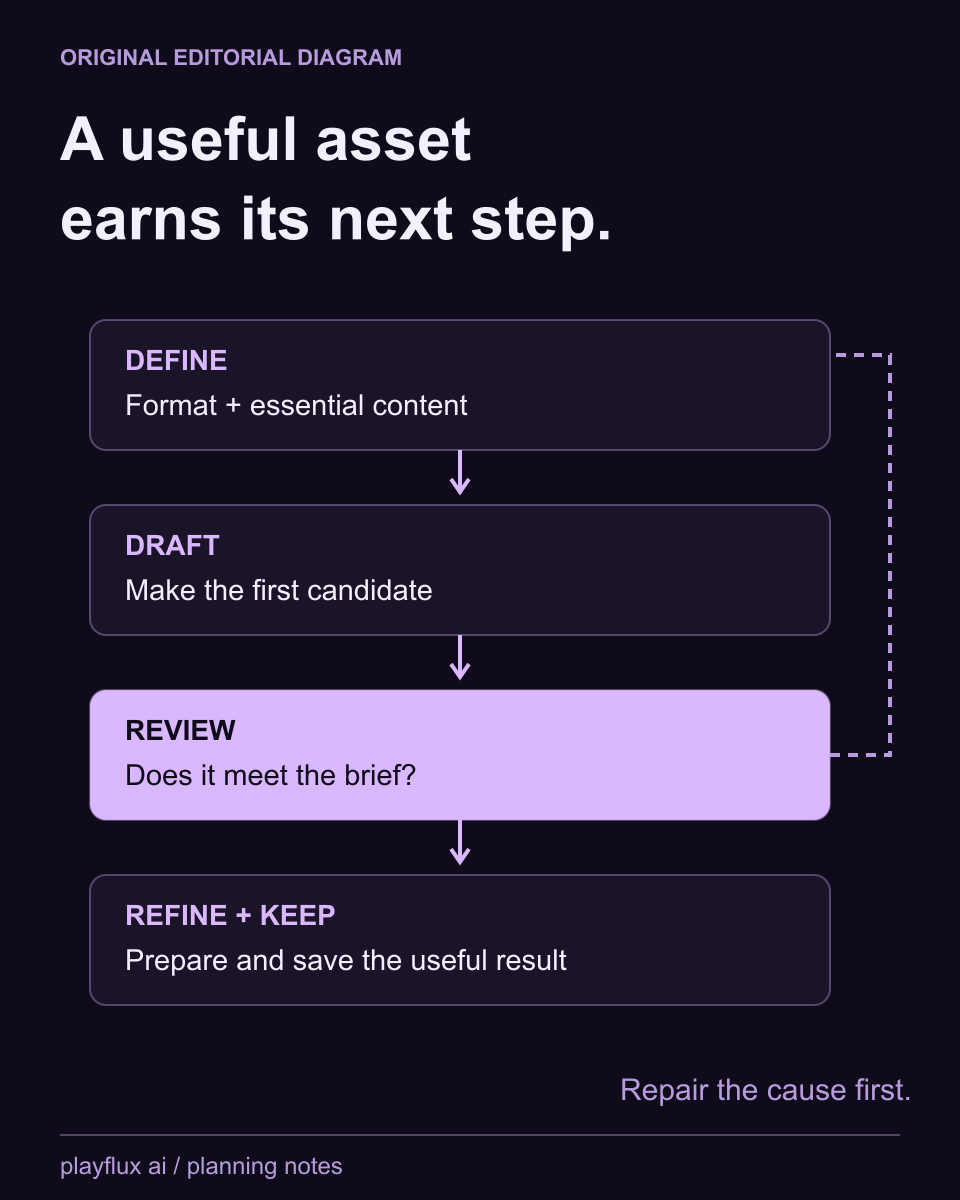
PlayFlux AI's Workflow AI Agent is described as a way to connect creative operations and save the chain for another run. Give each operation one job. Generation establishes the scene; a later refinement should solve a specific defect; final preparation produces the file you intend to keep.

Inspect the subject and framing before upscaling. Increasing the size of a wrong composition keeps the same mistake at a larger size. If several steps are charged separately, an early decision can also save work further down the chain.

The public FAQ establishes saved chains, but does not establish every pause, restart or inspection control. Check the current interface before relying on a specific handoff. Developer API access and pricing are handled through the support route linked by the provider's FAQ.

Explore the PlayFlux AI workflow FAQ ↗

A clear budget for each experiment

Count attempts as well as final assets.

PlayFlux AI describes credits as one-time, pay-as-you-go purchases without automatic renewal. The current FAQ lists a Basic pack of 20,000 credits for $19.99. It separately describes VIP benefits, including priority, higher limits and premium-model access.

A pack total does not reveal the cost of a selected model or prove access to every route. Read the actual operation price and account requirement before purchasing. Image, video and refinement operations can use different amounts.

Use the worksheet with a rate you have checked. For a multi-step workflow, add each step's cost to your per-attempt estimate. Its arithmetic stays in this browser; it does not connect to a PlayFlux AI balance or create media.

4 assets × 3 attempts = 12 planned attempts. Enter a verified per-attempt estimate to calculate credits.Assets × attempts × your entered credit estimate. Include generation, editing, upscaling or motion costs when they are separate operations.

Finish with a file you can find

Your project deserves a final copy.

The PlayFlux AI privacy policy updated in October 2026 says generated images and videos are automatically deleted 365 days after creation. Uploaded images and videos are not automatically deleted under that rule. Those are different retention conditions: an upload should not be assumed to disappear with a generated result.

Download accepted files while they are available. Keep the final asset, its brief and the settings you used in the same project folder. Open the downloaded file before deleting a gallery item or an account; the FAQ describes those deletions as permanent.

For distribution, check the applicable input, model and service terms. Payment and a downloadable result do not by themselves establish unrestricted commercial-use rights. Keep the permissions for reference material with the project.

Choose by the work in front of you

What do you need to reuse?

Before your next creation

PlayFlux AI questions, answered.

These answers use the provider's current public FAQ and October 2026 policies. Account-level availability and generation performance have not been tested.

Where should I begin with PlayFlux AI?

Start from the deliverable. Use an image route to find the visual direction, a video route for a clear motion goal, or a workflow when the same operation sequence needs to repeat. Set a small attempt budget and inspect the first result against your brief.

Does buying credits start a subscription?

The FAQ describes one-time credit packs without automatic renewal. VIP benefits are listed separately. Check the specific checkout's amount, inclusions and account requirements; do not assume a pack activates every premium model. The FAQ's bonus wording does not justify adding another bonus to its already stated pack count.

Does a saved workflow preserve the same character?

The documented saved object is a chain of operations. That does not establish automatic character identity or appearance consistency. Keep a separate character description and accepted visual reference, and inspect what the current workflow actually saves.

How long are generated files stored?

The October 2026 privacy policy sets automatic deletion of generated images and videos at 365 days from creation. It says uploads are not automatically deleted. Save wanted results yourself and use the provider's deletion controls for material you no longer want retained.

What are the content and rights boundaries?

The current Terms allow adult content for adults aged 18 or over, while prohibiting content involving minors, non-consensual material and rights violations. Work with original fictional adults and inputs you are entitled to use. This page covers creative planning; it makes no blanket output-license or commercial-use guarantee.

Can I use the calculator to check my live credits?

The worksheet only calculates the values you enter. It has no account access and cannot quote a model's current rate, make a purchase or generate an asset. Read the provider's selected operation price, enter it here and revise your estimate when the planned steps change.

Practical decisions

PlayFlux AI: plan the complete path from brief to final copy

A PlayFlux AI project benefits from a clear deliverable, an accepted starting asset and a defined review at each stage. Keep the PlayFlux AI attempts, source permissions and final handoff visible before adding another tool to the pipeline.

01

PlayFlux AI: Start with the deliverable

A PlayFlux AI project should name the final asset before choosing tools: one still, an edited picture or a short clip. That decision determines the necessary inputs and review stages. A PlayFlux AI workflow becomes easier to control when every step has a clear output to hand to the next.

Write the PlayFlux AI deliverable and acceptance criteria before requesting variations.

02

PlayFlux AI: Make the brief specific enough to review

For PlayFlux AI, define the original adult subject, composition, setting and the detail that must stay consistent. Put planned changes in a separate line. When comparing PlayFlux AI attempts, this lets you identify whether a result solves the brief instead of judging only visual novelty.

Keep the PlayFlux AI accepted brief with the selected output and input permission.

03

PlayFlux AI: Repair before expanding the pipeline

A PlayFlux AI still with an incorrect subject or crop should be repaired before becoming a motion input. Choose the smallest available edit that addresses the defect. Starting a later PlayFlux AI stage can add cost and complexity while carrying the same unwanted feature forward.

Inspect the PlayFlux AI starting frame before adding action or camera movement.

04

PlayFlux AI: Estimate attempts by production stage

A PlayFlux AI estimate should count source preparation, generation and revisions in the applicable listed units. Keep accepted deliverables separate from discarded attempts. The PlayFlux AI planning tool shows how assumptions change the total; it does not predict a success rate or a final checkout price.

Update the PlayFlux AI estimate when the actual action cost or revision count differs.

05

PlayFlux AI: Preserve a complete final copy

A finished PlayFlux AI project needs the accepted file, brief and relevant source material in a location you control. Inspect what was downloaded rather than relying on a preview. The PlayFlux AI storage conditions discussed below make a deliberate handoff more useful than assuming every generation stays accessible forever.

Keep the PlayFlux AI final asset separate from temporary experiments and rejected attempts.

06

PlayFlux AI: Choose the next workflow by its controls

When comparing PlayFlux AI with a model library or another creator, identify which control the project needs. Reproducible parameters, focused edits and motion inputs serve different jobs. A PlayFlux AI feature comparison should explain those jobs without inventing a tested quality winner or universal reuse license.

Follow the PlayFlux AI comparison that matches your next production decision and inspect its sources.


Compare the next workflow ↗

Go deeper into the next decision

All articles

Compare project commitments, asset rights, reusable characters, model eligibility and visual versus written deliverables.

Public product and policy review · October 16, 2026 · Provider pages read in a browser; no paid account or generation benchmark. Supplied photographs illustrate this publication.PlayFlux AI productWorkflow & credit FAQOctober 2026 TermsOctober 2026 privacy policy